The true cost of hiring a maid in Thailand
The full cost stack to hire a maid in Bangkok: salary (advertised at roughly 12,000–20,000 baht/month, statutory floor 400 baht/day), MOU work-permit fees of about 3,700–4,200 baht paid by the employer, food and accommodation in kind for live-in, and a one-off agency placement fee. Permit costs verified; salary and agency figures labelled estimates.

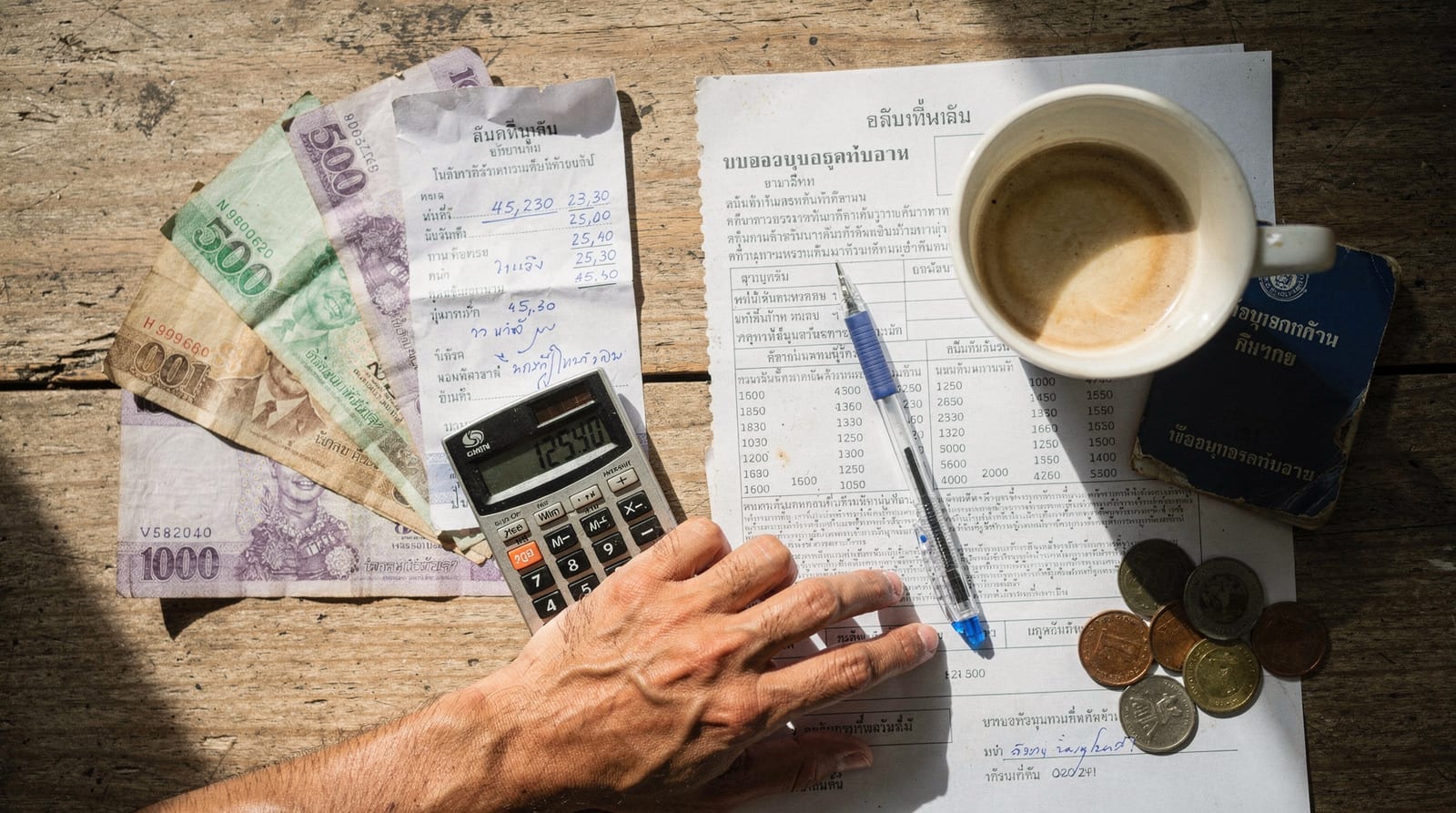
The short answer. What you pay to hire a maid in Thailand breaks into four parts:
- Salary — the dominant recurring cost. Bangkok live-in maids are advertised at roughly ฿12,000–฿20,000/month (estimate). The statutory floor is ฿400/day in Bangkok.
- Permit fees for a migrant (MOU) worker — about ฿3,700–฿4,200 in government charges, paid by the employer, renewed on a two-year permit cycle (verified components below).
- In-kind costs for live-in — food and accommodation, an estimated ฿3,000–฿5,000/month on top of cash wage.
- Agency placement fee, if you use one — a one-time ฿6,000–฿25,000 (estimate).
Permit figures are verified government fees. Salary, food, and agency figures are labelled market estimates. The line nobody publishes is the next one.
Why nobody publishes the real number
Almost every "cost of a maid in Thailand" page gives you one figure: a salary range. That is the easy number, and it is the least useful one. It ignores the government fees an employer pays to make a migrant hire legal, it ignores the in-kind cost of housing and feeding a live-in worker, it ignores the agency fee, and it never tells you which of these the law puts on you versus on the worker.
This page is the full total cost of ownership, the cost stack an employer carries, one line at a time. Where a number is fixed by statute, we cite it. Where the market sets it, we label it an estimate and refuse to invent a false precision. That distinction is the whole point: a few costs here are the law, and most are negotiable.
The full cost stack, line by line
This is the centrepiece. Read the "Who pays" column as carefully as the amount — it is where most employers, and a few agencies, get the law wrong. The example assumes a Bangkok live-in maid on the MOU (migrant) route, the most paperwork-heavy and therefore most complete case.
| Cost item | One-time or monthly | Amount | Who pays | Source / status |
|---|---|---|---|---|
| Monthly salary (Bangkok live-in maid) | Monthly (recurring) | ฿12,000–฿20,000 | Employer | Market estimate |
| Statutory wage floor underpinning that salary | Monthly (recurring) | ฿400/day (Bangkok) | Employer (legal minimum) | Verified — see wage floor |
| Food & accommodation in kind (live-in) | Monthly (recurring) | ฿3,000–฿5,000 est. | Employer | Estimate |
| Agency placement fee (if used) | One-time | ฿6,000–฿25,000 est. | Employer | Estimate |
| MOU work-permit components (migrant worker) | ||||
| Visa | One-time (per cycle) | ~฿500 | Employer* | Verified |
| Stay / extension | One-time (per cycle) | ~฿500 | Employer* | Verified |
| Work permit | One-time (per 2-yr cycle) | ~฿1,450 | Employer / chargeable to worker | Verified |
| Pink Card (registration card) | One-time (per cycle) | ฿60 | Employer* | Verified |
| Health insurance | One-time (annual) | ฿990 or ฿1,600 | Employer* | Verified |
| Medical check | One-time (per cycle) | ~฿500 | Employer / chargeable to worker | Verified |
| MOU permit subtotal | One-time / renewal | ~฿3,700–฿4,200 | Employer | Verified components |
| Recruitment / demand-letter cost | One-time | Varies | Employer only | Verified — law bars charging the worker |
| Permit renewal (next cycle) | Recurring every 2 years | Repeat of subtotal | Employer | Verified cadence |
Permit components and ~฿3,700–฿4,200 total: maidthailand.com VERIFIED FACTS 2026-06, Topic 6, citing the IOM Thailand Labour Migration Profile (Mar 2025) and a DOE-aligned employer guide; figures reflect the post-October-2023 fee schedule (confidence: medium — confirm the current schedule before relying on it). Health insurance shows the ฿990 (6-month) and ฿1,600 (12-month) options. *"Employer only" / "chargeable to worker": under the Royal Ordinance a worker may be charged only for passport, medical check, and work-permit fee at fixed rates; see who pays. Salary, food, and agency rows are market estimates, not statute.
One-time versus recurring — read the table this way
The cost stack splits cleanly into two clocks, and budgeting fails when people blur them.
- Recurring, every month: salary and, for live-in, food and accommodation. This is the bulk of lifetime cost. Over a two-year placement, salary alone dwarfs every fee below it.
- One-time at the start: the agency placement fee and the first round of MOU permit fees.
- Recurring, but slow: the permit fees come back. The work permit on the MOU route runs two years, renewable once to a four-year maximum, then a cooling-off period applies. Health insurance is annual. So the ฿3,700–฿4,200 is not a single payment — budget it again at renewal.
For a Thai citizen there is no permit stack at all: no visa, no work permit, no Pink Card, no MOU. The only legal cost beyond salary and (if live-in) keep is the written MR 15 contract. That makes a Thai hire the cheapest path on paper, a point we make in full in the main hiring guide.
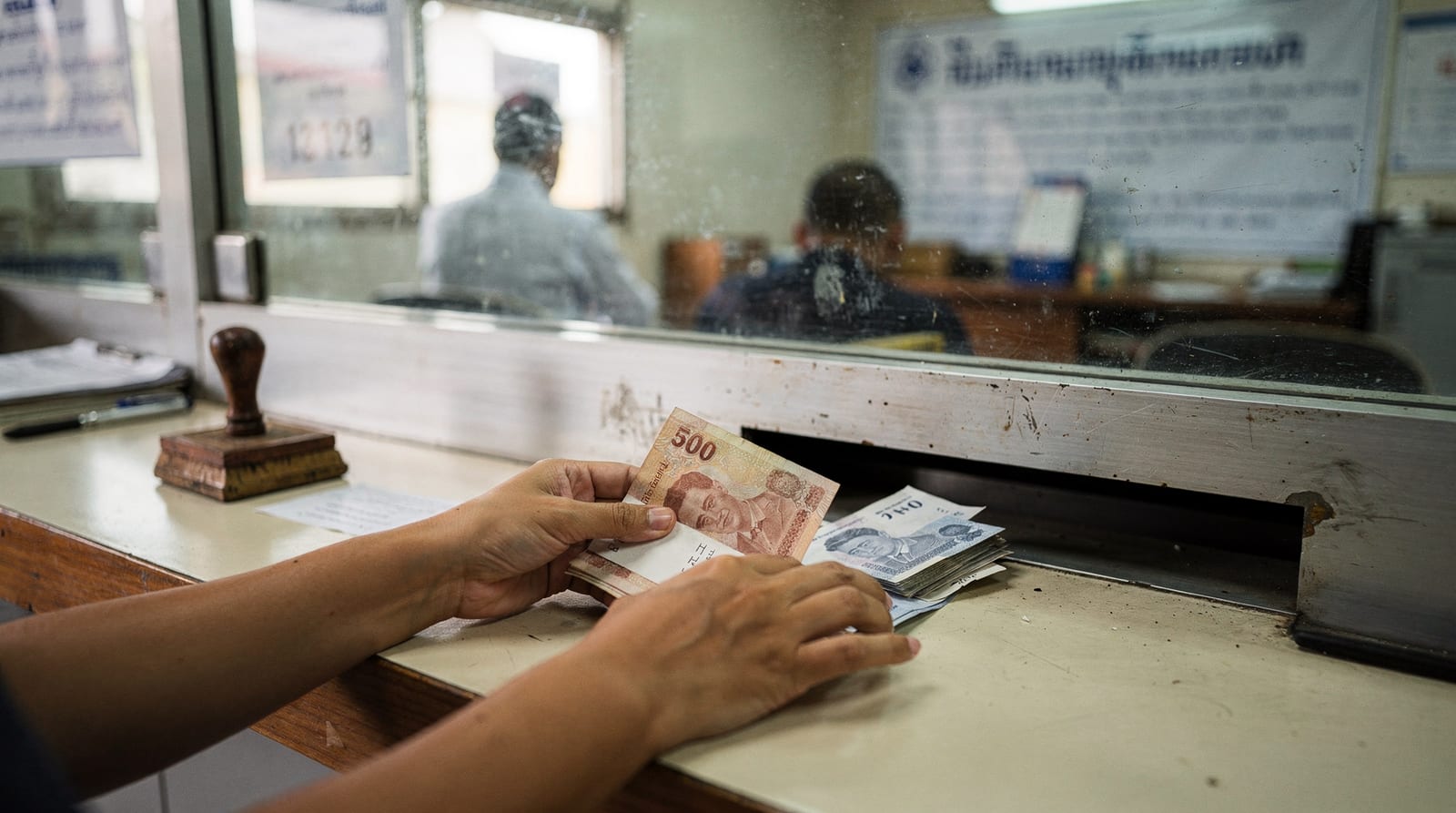
Who legally pays what
This is the part agencies most often blur, and the part the law is clearest on. The governing instrument is the Royal Ordinance on the Management of Employment of Foreign Workers B.E. 2560 (2017), as amended in 2018.
The recruitment cost — the demand letter, the agency's sourcing work, the cross-border process — is the employer's to bear. A migrant worker may legally be charged only for three things, at fixed government rates: their own passport, their medical check, and the work-permit fee. Everything else is on the employer.
The Ordinance backs this with a specific prohibition. Section 49 bars anyone from demanding money or property from a migrant worker beyond those fixed fees; the penalty runs to up to six months' imprisonment and/or a fine of twice the sum unlawfully collected.
The trap. If an agency proposes to "recover" its placement fee from the worker's wages over the first months, that is debt bondage, and it puts the cost on the wrong person in law. The cost stack above is an employer's stack for a reason. If an agency tries to move it onto the worker, that is your signal to find another agency.
One honest caveat the surveys make unavoidable: in the real Myanmar–Thailand corridor, workers often end up paying far more than the legal cap — independent research puts the figure at roughly four to nine times the official ceiling. That is the gap between the law and enforcement, not the law itself. The law is unambiguous about who should pay. (Corridor cost-gap figures: VERIFIED FACTS Topic 6, citing the Five Corridors Project and HaRDstories.)
The wage floor — ฿400/day, and it now covers maids
Two facts here are commonly stated wrong on expat forums, so read them carefully.
- The Bangkok minimum wage is ฿400/day, set by Wage Committee Notification No. 14, effective 1 July 2025. The older ฿372 figure is stale. Phuket is also ฿400; the national range runs from ฿337 to ฿400 depending on province, and the rate that applies is the one for the province where the worker works.
- It applies to domestic workers. Until 2024, household work sat outside the minimum-wage rules. That changed with Ministerial Regulation No. 15 (B.E. 2567), in force since 30 April 2024, which extended the minimum wage — along with paid holidays, a weekly rest day, and other protections — to domestic workers, Thai and migrant alike. There is no special, lower "maid rate."
At ฿400/day over a roughly 22-day month, the statutory floor lands around ฿8,800/month. Market salaries sit well above it, which is why the floor rarely binds in practice, but it is the legal minimum, it is enforceable, and a contract that pays below it is unlawful. The full set of MR 15 entitlements, and what they cost you to honour, is in our MR 15 explainer. (Wage and MR 15 facts: VERIFIED FACTS Topics 1, 2, 5, citing the Thai Ministry of Labour, the ILO MR15 employer factsheet, and Tilleke & Gibbins.)
Salary — the honest estimate, labelled
Salary is the largest line and the one we will not pretend to know to the baht. What follows is a market estimate, drawn from agency listings and expat guides, not a survey we ran.
| Role / arrangement | City | Monthly estimate | Confidence |
|---|---|---|---|
| Live-in full-time maid (incl. room & food) | Bangkok | ฿12,000–฿15,000 | Medium |
| Live-in maid, agency mid-range | Bangkok | ฿15,000–฿20,000 | Higher |
| Live-out full-time maid | Bangkok | ฿15,000–฿18,000 | Medium |
| Part-time / day maid | Bangkok | ฿150–฿300/hour | Higher |
| Live-in maid, upcountry / rural | Chiang Mai & rural | ฿7,000–฿10,000 | Low (anecdotal) |
Salary ranges are labelled market estimates from VERIFIED FACTS Topic 9 (agency and expat-guide triangulation: Kiidu, Ayasan, bluuu, BKK Kids, ExpatDen, Fambear); confidence as marked. These are not a measured cohort. For the full city-by-city picture, including nanny and carer roles, see the Salary Atlas 2026.
Two things matter more than the exact number. First, a live-in salary and a live-out salary are not comparable — the live-in figure already absorbs housing, so add the food-and-accommodation line before you compare it to a day maid's cash wage. Second, the agency mid-range sits above the direct-hire range because the agency fee and the screening are baked into a higher placed salary as well as the one-off fee.
Food and accommodation for live-in
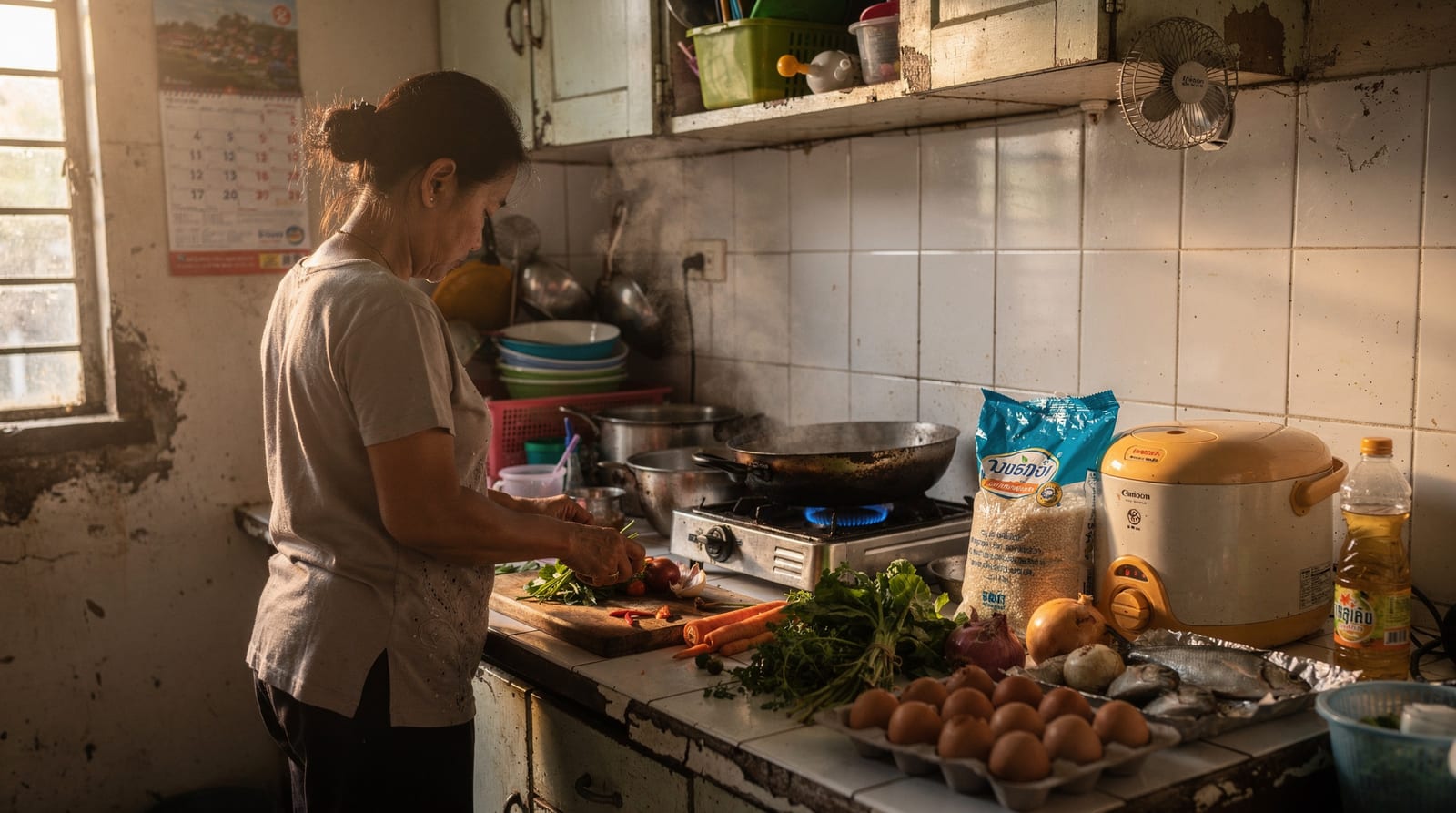
For a live-in worker, you are providing a private room and meals. We estimate this at ฿3,000–฿5,000/month in real cost — groceries plus the marginal cost of the room and utilities. This is an estimate, not a statutory figure, and it varies enormously with how your household already runs.
The legal point underneath it: under MR 15, the value of food and lodging cannot be used to push the cash wage below the statutory minimum. Room and board are on top of the wage floor, not a substitute for part of it. A contract that says "฿7,000 cash because room and board make up the rest" is below the Bangkok minimum and unlawful.
The agency placement fee
If you hire through an agency, expect a one-time placement fee. We estimate the typical range at ฿6,000–฿25,000, depending on the role, the nationality sourced, and whether the agency also runs the permit paperwork. This is a labelled estimate, not a fixed rate — agencies price freely, and you should ask for the fee itemised before you sign anything.
The fee buys time, screening, and a replacement guarantee. It does not buy a way around the permit fees or the wage floor; those sit on top of it. And it must never be recovered from the worker — see who pays. For the full agency-versus-direct decision, the twelve questions to ask, and the red flags, work through the main hiring guide.
Renewal cadence — budget the permit again
The single most-missed cost is the second one. The MOU work permit runs two years, renewable once, to a four-year maximum, after which a cooling-off period applies before the worker can return. So the ฿3,700–฿4,200 permit stack is not a one-and-done payment — plan for it to repeat at the two-year mark, with the health-insurance component recurring annually inside that.
The mechanics, the checkpoints, and the documents are in our MOU process explainer, and the permit-fee detail in the work-permit cost breakdown. (Permit cycle: VERIFIED FACTS Topic 6, citing the IOM Thailand Labour Migration Profile.)
A worked example — two years, all in
To make the stack concrete, here is a Bangkok live-in Burmese maid on the MOU route over a full two-year cycle. Salary is held at a mid estimate; permit fees are the verified subtotal.
| Item | Basis | 2-year cost |
|---|---|---|
| Salary | ฿15,000/mo × 24 (estimate) | ฿360,000 |
| Food & accommodation | ฿4,000/mo × 24 (estimate) | ฿96,000 |
| MOU permit stack | One cycle (verified) | ~฿4,000 |
| Agency placement fee | One-time (estimate) | ฿15,000 |
| Two-year total | — | ~฿475,000 |
Illustrative only. Salary, food, and agency lines are labelled estimates (VERIFIED FACTS Topic 9); the permit stack is the verified subtotal (Topic 6). Your number will move with salary, neighbourhood, and whether you hire direct. The point of the example is the proportion: salary and keep are over 95% of lifetime cost, and the fees everyone obsesses over are under 5%.
Frequently asked questions
How much does it cost to hire a maid in Bangkok in 2026?
What is the total work-permit cost for a migrant domestic worker in Thailand?
Who legally pays the recruitment and permit costs?
Does the 400 baht/day minimum wage apply to a live-in maid?
Primary sources
- MOU permit components and ~3,700–4,200 baht total — IOM Thailand Labour Migration Profile (March 2025) and a DOE-aligned employer guide; post-October-2023 fee schedule (confidence: medium — confirm current schedule)
- Who legally pays / Section 49 recruitment-fee prohibition — Royal Ordinance on the Management of Employment of Foreign Workers B.E. 2560 (2017), as amended 2018
- Corridor cost-gap (workers pay roughly 4–9x the legal cap) — Five Corridors Project; HaRDstories
- Bangkok minimum wage 400 baht/day, effective 1 July 2025 — Thai Ministry of Labour, Wage Committee Notification No. 14
- Minimum wage applies to domestic workers since 30 April 2024 — Ministerial Regulation No. 15 (B.E. 2567); ILO MR 15 employer factsheet (June 2025); Tilleke & Gibbins
- Market salary ranges — agency and expat-guide triangulation (Kiidu, Ayasan, bluuu, BKK Kids, ExpatDen, Fambear); labelled estimates
Keep reading
How to hire a maid in Thailand: the 2026 guide
Two facts decide a Thai maid hire: who you can legally employ (Thai needs no permit; foreign workers only via the MOU channel with Myanmar, Laos, Cambodia or Vietnam; a Filipino household maid is not lawful) and the two non-negotiable documents — an MR 15 contract and, for migrants, a work permit. Budget a live-in Bangkok maid at roughly 15,000–25,000 baht/month all-in.
Live-in vs day maid in Bangkok — cost and the honest trade-offs
A day maid is cheaper to start and lighter on your home; a live-in maid costs more all-in once you add a private room, food and utilities, but buys far more availability. The legal floor is identical for both under MR 15 — one paid rest day, 13 paid holidays, paid leave, and the 400 baht/day Bangkok minimum wage.
Filipino vs Thai vs Burmese maid in Thailand — the honest comparison
Legal reality first: a Filipino cannot be lawfully hired as a maid by a private Thai household — Thailand admits foreign domestic labour only via the MOU with Myanmar, Laos, Cambodia and Vietnam. A Thai national needs no permit. Market pay runs Filipino above Thai above Burmese, driven by English, but exact baht gaps are anecdotal.